Thursday, 19 November 2015

Responses from Keystone Predators - Gray Wolves

Sorry for the lack of posts in the past 1.5 week, I was caught up finishing two important essay deadlines during reading week :’(  But good news is, we will be focusing on a rather new aspect of the topic today – Responses from Keystone Predators. For those who are new, just to recap, my chosen topic focuses broadly on how global warming has recently affected a range of biodiversity, and the observed responses they have taken to adapt to these rapid changes in climate. Previously, I have focused on observed shifts in vegetation (eg. Arctic Greening) and biomes worldwide, as well as looking at how North Sea fishes are migrating northwards to a whole new level! So if you’re interested, feel free to browse through and comment!  

Anyways, back to the point on today’s post. As mentioned previously, average temperatures worldwide have climbed about 0.6 degrees in the past century, and a further increase in 1.4- 5.8 degrees is expected over the 21st century.  For certain regions in America, this means major shifts in snowfall patterns and length of winter that might potentially cause tremendous observed changes in species interaction. Lets take a deeper look into how the keystone predator – Gray Wolves - have recently responded to changes in snowfall patterns in 2 regions, and the direct/indirect cascading effects it has had on other trophic levels (or so called the ‘trophic cascade’).

Gray Wolf as Important Climate Change Buffers

The first case study originates from Yellowstone National Park, where winters have extended for more than a week between 1948-2005. Luckily for scavenger species there, Gray wolves close to extinction at one point have returned to play a vital position in easing the consequences of shorter winter on the local food chain.
So you ask, how do they act as climate change buffers and help other local species to cope with climate change? Well, basically they provide a reliable supply of carricon (decaying flesh of dead animals) for scavengers throughout the whole winter season, regardless of whether it's a mild or severe winter.

Let me explain this more clearly. During severe winters, more elk dies, providing important food sources for a wide range of scavengers in the Yellowstone National Park, such as ravens (Corvus corax), magpies (Picapica), grizzly bears (Ursus arctos) …and many more for their survival and reproduction.  Due to climate change, however, warmer (milder) winters locally cause an increase in survival rate of elks, resulting in food shortages for scavengers when other food resources are scarce during certain times of the season. Luckily with the help of Gray wolves tend to leave their leftovers behind and elks are frequently killed despite of the duration of severity of the winter season.
Elk and other species in Yellowstone National Park, USA
Thereby, it is clear here that Gray wolves tend to act as buffers against recent impacts of global warming by helping to prolong the timing for scavenger to better respond and adapt to changing conditions. Elsewhere, however, climate change has led to increase snowfall in wetter regions, which has affected wolf and moose population dynamics.

Wolf-Moose, Moose-Fir Dynamics

In a study undertaken in Isle Royale National Park, USA, it was clear that Gray wolves have responded to increases in snowfall related to changes in NAO (North Atlantic Oscillation) by hunting in larger packs. As a result of to greater killing efficiency, the number of local moose population (Alces alces) is three times more likely to be killed daily in comparison to years with less snowfall when Gray wolves hunted in smaller packs. However, the impact does not stop just quite yet… It was found that the decline in moose population led to a reduction in herbivory and browsing pressure on fir trees and saplings – which have resulted in an observational increase in balsam fir (Abies balsamea) locally.
Gray Wolves hunting and chasing a Bull
Moose in Isle Royale National Park

Gray Wolves hunting in packs
in Isle Royale National Park


Clearly, we are just starting to understand the interactions between top predators (in this case Grey Wolves) and recent climate patterns across the globe. In Yellowstone National Park, Grey Wolves tend to alleviate/buffer against the effects of rapid climatic changes on scavengers’ food availability. In Isle Royale, behavioral responses of Grey Wolves to changes in snow depths have led to changes in predator-prey relationship amongst 3 trophic levels:  wolves– moose- fir. Together these evidences begin to give insight into the expected changes that may potentially occur to boreal ecosystem due to effects of climatic changes on top predators. Obviously there will be ‘winners’ and ‘losers’ with species increasingly trying to adapt to climate change. However, should we pay extra attention to those that occupy a place at the top of the trophic level and interfere with the changes in species interaction observed?

Some argue that it is important to interfere within the changes in species interactions observed, but clearly these responses have been generally positive. Hence in my opinion, we should leave the local ecosystems and changes in species interaction observed alone just yet, as I believe they will find a way back to a equilibrium/stable state from the new condition caused from changes in species interaction, unless there have been major changes that are damaging certain endangered species.

We need to survey species
interaction! There are too
many ways...
Although these cases do not show how certain keystone predators have been endangered by climate change (rather they have responded generally positively here!), I do believe that it is vital to invest our resources into protecting and managing species at a higher trophic level as a focus for managing the entire community (sort of like top-down management style).  This is because they are generally the central supporting element in local ecosystems, and as mentioned, they cause direct/indirect cascading effects on other trophic levels that we may or may not have observed yet. The first step in doing this I believe is to obtain more information on keystone predators (as our overall knowledge is generally poor). Department of Environment, Climate Change and Water NSW have suggested that this includes obtaining more information on their identification, how they interact with climate change and their ecology/biology in order to develop further adaptation and management. 


What are your opinions?


Friday, 6 November 2015

Troubling Transformation In Arctic – But Little To Do With Ice!


Some of you guys doing GEOG3057 may have received an email from Anson on an event called ‘Hot and Bothered? Species Vulnerability to Climate Change’  held by ZSL. It sounded interesting and I wanted to step away from my dissertation for a bit, so I decided to go. Though it wasn’t the main focus of the talk, what captured my attention was the brief touch (literally 2 mins max.) on ‘Arctic Greening’ by Dr. Richard Pearson from UCL. Following on Tuesday’s post on shifting vegetation and biomes, I thought it would be nice to add on to it.
Dr. Richard Pearson giving his speech on Arctic Greening (Author's Photo)
Dr. Richard Pearson showing his research on present day (2013) and projected shifts (2050s onwards) in Arctic Vegetation

‘Arctic Greening’  - Most Recent Observations
The current pattern we are increasingly observing in the Arctic is ‘greening’. This trend coincides with the increase in Arctic temperatures (hence shrubs, plants, lichens are loving it!), which have rapidly risen twice as much as the global rate. Way back during the Early Holocene, increases in temperature in the Alaskan Arctic led to one or more large-scale shrub invasions in the region suggesting that vegetation in the region are most likely able to respond to climate changes very rapidly.

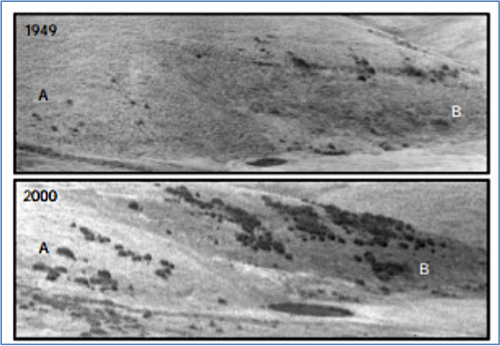
If you are skeptical, here are some concrete evidence of photographs showing an increase in vegetation cover in Alaskan Arctic. The first set of photographs shows an increase in density of shrub patches and an expansion of shrubs into areas that were shrub-free in the same location at Ayiyak River between 1949 and 2000.
The Ayiyak River in 1949 and 2000
Note: Point A and B are in the same location in both photographs 
The second set of photographs below shows the arrival of spruce stands (A) and an increase density of shrubs (B).
The Kugururok River in 1950 and 2000
Note: Point A and B are in the same location in both photographs 

Future Predictions
So what does the future hold for Arctic landscapes?  Well, we will never be a 100% sure, but using statistical and ecological niche models, Dr. Richard Pearson and his fellow researchers predicts that potentially more than half (48-69%) of the vegetated regions will likely result in a change of physiognomic class, and woody plantations may increase up to 52% under climate change predictions for 2050s and restricted tree dispersal. Specifically, Alaska’s North Slope that is currently dominated by graminoids (grasses) will potentially be encroached by low-shrub and dwarfshrub tundra. There will also be a massive expansion of tree cover in regions, such as Northern Siberia.
What will it mean?
Continued ‘greening’ in Arctic will create/enhance positive climate feedbacks. For example, increases in woody vegetation will likely enhance evapotranspiration rates and atmospheric water vapour, which will act as a positive feedback to regional heating. An increase in darker woody plantations will reduce albedo and result in positive feedback to warming. The consequences of the shift would also create impacts beyond the Arctic, as many  species migrate seasonally from the lower latitudes in search for open space, such as ground-nesting birds.  

But wait for it… there are some positives in light of all the negatives
In the arctic region, increase shading derived from the increase in shrub canopy will reduce temperatures of soils, which may potentially slow carbon release from melting of permafrost, hence, acting as a negative feedback to global warming.

Short and brief, but hope you liked it! Have a great reading week guys! :) 


Monday, 2 November 2015

Shifts in Biomes!


Hello everyone!

I was going through some articles yesterday and I found this diagram on the right that nicely summarize some ideas I intend to focus on in my blogs. It shows a range of ‘climate’ change mechanisms that are likely driving responses from biodiversity (pink box), and potential impacts/responses from different levels of biodiversity (blue box).  The reason why I highlighted ‘climate’ because there are other factors that we must never forget, such as land use change, exploitation of resources and so on…. that are also driving recent responses observed!

Today I’ve chosen to focus on the bottom of the diagram (ironically at the very top of the biodiversity chain) – BIOMES. Unlike last week, I am going to explore at a higher level of biodiversity, and how climate change is affecting vegetation communities worldwide that can potentially be devastating enough to have an impact on biome integrity.
What are Biomes?
For those that haven't crossed paths with this term, biomes are essentially large geographical areas with flora and fauna (plants and animals) that have common characteristics due to similar climates over a range of different continents. They are often defined by abiotic factors, such as soil types, climate patterns, relief, and vegetation. Here’s a simplified map version of major biomes on earth:

                                             Simplified version of major biomes on earth


Importance of Biomes
One of the main concerns of anthropogenic climate change has been the potential response from terrestrial biosphere. It is not surprising owing to its importance for us, such as supplying us with timber, food and other life essential… as well as for ecosystem around the world. It plays a large role in maintaining biodiversity, carbon sequestration and feedbacks in the biosphere. Changes in vegetation structure will largely influence the balance and equilibrium of the ecosystem; for example, it could influence runoff and hence the amount of seasonal streamflow; as well as habitats that will modify species interaction and trigger widespread responses from the ecosystem.   


Climate changes and its impacts on biomes
There are considerable evidence that suggest anthropogenic climate change is already driving changes in vegetation structure, distribution and productivity. The underlying effect of global warming on vegetation structure mainly resides in the biochemical and physiological influences of temperature, atmospheric CO2 concentration and water availability on terrestrial plant growth. In warmer regions, it is predicted that forest dieback may occur and terrestrial plants may face water stress due to the increases in temperature (causing faster evapotranspiration) and a potential reduction in precipitation in certain regions. Whereas, in mid-to-high latitude areas that are more chilly, predicted rise in temperatures will cause a longer growing season and an increase in vegetation productivity (NPP).  But also, other factors such as increases in wildfire and changes in climate that exceed the physiological thresholds for vegetation may alter plant mortality and recruitment in an area. The replacement of more dominant and resilient species that are able to tolerate the changing conditions can result in an entire shift in biome of an area. Therefore, as global warming continues to take place, how vegetation patterns will change is expected to vary considerably amongst different regions.


Current Shifts
It is clear that climate change is shifting vegetation both latitudinally and elevationally worldwide. Researchers at University of California, Berkeley estimated that between 1901-2002, mean temperatures increased significantly on 76% of land worldwide, especially in subarctic, temperate and boreal ecosystems. Biome shifts that have been noticeable include dieback of trees and retracting of woodlands to grasslands in the Sahel, reducing ecosystem services it brings to many people (forest wood for cooking / supply of water) in that region. Nevertheless, the noticeable process of shrublands encroaching onto Arctic tundra is also a huge problem for many endangered species.

Picture showing a mixture of grassland
 and woodland - shifts observed in Sahel

Map showing the Sahel region
However, one of the main concerns that ecologist and scientists have raised are ‘tipping points’, where exceeding ecosystem thresholds may potentially cause irreversible shifts and changes in major biomes. A study showed that tropical biomes, such as rainforest, desert and savanna in Africa and South America are tied to certain climate tipping points, where when climate thresholds exceed they don't gradually shift through intermediate states, but rather ‘tip over’ where they suddenly switch to other ecosystems.


Future predictions
In terms of future predictions, Alo and Wang (2008) simulated 8 different GCMs climate projections with a global vegetation model to estimate changes in vegetation near 2100. They found a consistent pattern of poleward expansion and treeline shift of boreal and temperate forests towards higher latitudes at the expense of tundra and alpine ecosystems across all the GCM scenarios. They also suggest that a widespread vegetation degradation in the tropics will occur, especially in South Africa and South America due to an increase in drought deciduous trees at the expense of evergreen trees due to changing moisture conditions.

Similarly, Lapola and his colleagues’ analysis on potential future distribution of biomes in tropical South America suggests that increases in carbon dioxide concentration and/or drier season persists longer than four months, then Amazonian rainforest could likely be replaced by drier biomes, such as shrublands, tropical savannahs and even semi-deserts.

Picture showing Amazonian Rainforest.... that in the future could potentially look different from a shift to drier biomes

… To avoid this we need to manage!

To avoid this, adequate adaptation measures must be put in place according to vulnerability by ecologist. But also a significant reduction in greenhouse gas emission must be made to avoid the potential devastating consequences to global vegetation – which also will have potential impacts on wildlife, species interaction, biosphere feedbacks and last but not least...our (human) well-being! 

Personally I think that instead of focusing on individual species (not saying that they aren't important), but maybe we should focus more on researching/mitigating/managing biomes and ecosystems. If we can't secure ecosystems and habitats that are deemed as essentials for species, then many species without adequate adaptability mechanism will lose out giving that some ecosystems are tied to certain 'tipping points'. What do you think? 

Anyways! Have a great week and see you all in a few days :)